It's not easy liking football. It's not something that we can easily justify either; football is, when everything is taken into consideration, an ultimately inconsequential pursuit. Yes, we can turn a blind eye to football's futility and embrace it as a valuable outlet of escape from the 'real world', as if our lives are divided into what exists and what does not. But the myriad evils of football make it harder still to justify taking an interest, even if it is treated as a means of withdrawal from everyday life and all its problems; why subject ourselves to the misery of our teams' failures, the vitriol of opposition fans, the alleged corruption of football's ruling body? It appears, therefore, that not only is football an ultimately pointless pursuit, it is a masochistic one. If this is the case, then it is unquestionably the most popular form of masochism in the world. Football, as you may have noticed, is enjoyed by quite a number of people.
Almost all of these people fell in love, if such a romantic notion can be applied to this cruel game, with football in their childhood. This love is usually instilled by the preceding generation, though many pick it up even without any parental prompting. Only in the naive, innocent years of childhood does the culture of football appeal; you don't hear of people in their twenties suddenly embracing the sport after a lifetime of indifference. Those blessed with apathy to football can never appreciate the agonising life they have been spared. While we wallow in the depraved glory of the clubs we support, they bask in glorious ignorance. Imagine a life not dictated by some perverse desire to keep 'up-to-date' with the latest football news. That means no more hours dedicated to reading yet another piece on why England don't beat good football teams, no more hours spent checking your Twitter feed to see what transfers are brewing, and no more hours parked in front of a television watching football matches (yes, actually watching a game!). Think of the things you could have accomplished with all that lost time. You could have learned another language, you could have read hundreds of books, you could have mastered an instrument. But instead, we chose football and all of its accompanying ills.
It is the lull of a June without an international tournament* that provokes this post. Firstly because there is precious little else to write about due to the dearth of games. (Regardless of my numerous gripes, I can't help but love watching football matches.) But I write this post primarily because of the transfer season.
Of all the sheer rubbish rammed down our throats by the football media that we feel compelled to swallow, paralysed for fear of not being "in the know", transfer rumours must surely sit atop the pile of malignant banality. Fuelled by football agents and football journalists with agendas to further, they are presented to us, the gullible, needy fans, as tantalising morsels of vital information that we cannot do without. The reality, of course, is starkly different; everyone knows that a great deal of these rumours are entirely fabricated, or at least painted with a coat of spuriousness. Yet these rumours thrive; they are an inescapable part of a football fan's life, no matter how we try to ignore them. Media outlets dedicate hundreds of words to stories based on little more than unverified quotes, purported sightings of players at club grounds or incredible (in its most literal sense) claims by agents.
Dawn, I'm fed up. I don't want to be part of a footballing culture of hearsay and corruption any more. Still I know I'm not ready to sever ties with football for ever. How could I turn my back on the game of Puskás, of Cruyff, of Laudrup? Football has us by the scruff of the neck and there's nothing we can do about it. I have no choice but to cast aside my complaints and submit to football, the omnipotent force for good and evil. It will always maintain a stranglehold on my life, no matter what grieveances I have. Acquiscence is the easiest way out. Liking football isn't easy, but I can't imagine life without it.
*The Copa América doesn't start until July. And yes, I'm ignoring this.
Monday, 27 June 2011


Monday, 20 June 2011
Emile Heskey, an ode to - An acrostic
Earnest
Musings on his greatness
Invite only scorn.
Leader of all men,
Even you.
He of skill
Eternally unmatched, though
Some try.
King of men,
Emperor of all mere mortals.
Your leader.
Heskey.
It's the silly season. I was bored. I'm sorry.
Musings on his greatness
Invite only scorn.
Leader of all men,
Even you.
He of skill
Eternally unmatched, though
Some try.
King of men,
Emperor of all mere mortals.
Your leader.
Heskey.
It's the silly season. I was bored. I'm sorry.
Saturday, 18 June 2011
Brick by Brick - Waterford's full-back problem
The full-back problem has dogged Waterford hurling for years. Declan Prendergast, Kevin Moran, and now Wayne Hutchinson are just some of the players who have filled the berth to no great success in recent times. It seems that the elusive All-Ireland title will always be beyond our grasp until a solution is found. Kevin Downes' second-half demolition of Hutchinson and then Darragh Fives served only to highlight how far we have yet to go if we are to add to those fabled successes of '48 and '59.
It is no coincidence that today's two hurling giants boast a plethora of quality full-backs. When Kilkenny were shorn of the peerless Noel Hickey due to a serious knee injury in 2009, JJ Delaney was there to take his spot. Current All-Ireland champions Tipperary know that should Paul Curran ever stutter, Pádraic Maher is available to step in. This is a luxury that Waterford can only dream of, as a conveyor belt of full-backs are tested and rejected. Declan Prendergast is perhaps the only player to hold the spot for a prolonged period in the last few years, but his reputation as a full-back was almost irreparably damaged after the All-Ireland semi-final of 2007.
Is consistency the solution? Perhaps if Hutchinson, or even Liam Lawlor, were given an extended run in the side, then we would reap the benefits of their experiences. Unfortunately, knockout format as it is, the Championship is no place to be bedding in players. It is the League, therefore, that presents the best platform for experimenting and developing. But it takes no genius to see the gulf in quality between League hurling and its summertime counterpart. It would appear, though admittedly on the basis of only one game, that Hutchinson's apprenticeship in the League was futile. When Championship day came around, he was comprehensively trumped by Downes. A consistent run in the side does not guarantee good performances by any means.
This is not to say that Hutchinson should be discarded as an afterthought. Clearly he has potential, and given the appropriate application and nurturing, he will have an important part to play in Waterford hurling in the years to come. However, an alternative must be found to secure short-term gain, without sacrificing long-term progress. This much was evidently on Davy Fitzgerald's mind when Michael Walsh was tasked with marking Downes after he had outclassed both Hutchinson and Fives.
Brick is undoubtedly among the finest centre-backs of his generation. His sheer strength is almost unmatched in the game. Truly he is the archetypal centre-back, the dominating figure on which the rest of the team hinges. Yet all signs point to him being deployed as a full-back in the Munster final. Should he line up at number 3, Fitzgerald runs the risk of losing one of the team's most important assets. However, such is Brick's talent and reliability, Fitzgerald can rest easier knowing that Tipperary's (assuming they beat Clare) full-forward line will be quiter than usual.
While I would gently advocate the use of Brick at full-back in the immediate future, Fitzgerald must work on finding a permanent solution as soon as possible. Brick won an All Star at centre-back for a reason, and playing him elsewhere for any more than a couple of matches would be foolish in the extreme. So while Hutchinson lacks that little (but crucial) bit of experience and is perhaps short of confidence, playing Michael Walsh at full-back seems the most viable option. The looming threat of the McGrath-Corbett-Kelly axis would not seem nearly as insurmountable with Brick at full-back (not to mention the highly impressive Noel Connors in the corner).
There are, of course, plenty of causes for optimism. John Mullane showed last Sunday that he is still at the top of his game and the performances of David and Brian O'Sullivan, and Pádraig Mahony in particular, were encouraging to say the least. Once the issue at number 3 is resolved, there is enough quality throughout the rest of the squad to mount yet another All-Ireland challenge. It may be just beyond our grasp just now, but Liam
may be draped in blue and white yet.
It is no coincidence that today's two hurling giants boast a plethora of quality full-backs. When Kilkenny were shorn of the peerless Noel Hickey due to a serious knee injury in 2009, JJ Delaney was there to take his spot. Current All-Ireland champions Tipperary know that should Paul Curran ever stutter, Pádraic Maher is available to step in. This is a luxury that Waterford can only dream of, as a conveyor belt of full-backs are tested and rejected. Declan Prendergast is perhaps the only player to hold the spot for a prolonged period in the last few years, but his reputation as a full-back was almost irreparably damaged after the All-Ireland semi-final of 2007.
Is consistency the solution? Perhaps if Hutchinson, or even Liam Lawlor, were given an extended run in the side, then we would reap the benefits of their experiences. Unfortunately, knockout format as it is, the Championship is no place to be bedding in players. It is the League, therefore, that presents the best platform for experimenting and developing. But it takes no genius to see the gulf in quality between League hurling and its summertime counterpart. It would appear, though admittedly on the basis of only one game, that Hutchinson's apprenticeship in the League was futile. When Championship day came around, he was comprehensively trumped by Downes. A consistent run in the side does not guarantee good performances by any means.
This is not to say that Hutchinson should be discarded as an afterthought. Clearly he has potential, and given the appropriate application and nurturing, he will have an important part to play in Waterford hurling in the years to come. However, an alternative must be found to secure short-term gain, without sacrificing long-term progress. This much was evidently on Davy Fitzgerald's mind when Michael Walsh was tasked with marking Downes after he had outclassed both Hutchinson and Fives.
Brick is undoubtedly among the finest centre-backs of his generation. His sheer strength is almost unmatched in the game. Truly he is the archetypal centre-back, the dominating figure on which the rest of the team hinges. Yet all signs point to him being deployed as a full-back in the Munster final. Should he line up at number 3, Fitzgerald runs the risk of losing one of the team's most important assets. However, such is Brick's talent and reliability, Fitzgerald can rest easier knowing that Tipperary's (assuming they beat Clare) full-forward line will be quiter than usual.
While I would gently advocate the use of Brick at full-back in the immediate future, Fitzgerald must work on finding a permanent solution as soon as possible. Brick won an All Star at centre-back for a reason, and playing him elsewhere for any more than a couple of matches would be foolish in the extreme. So while Hutchinson lacks that little (but crucial) bit of experience and is perhaps short of confidence, playing Michael Walsh at full-back seems the most viable option. The looming threat of the McGrath-Corbett-Kelly axis would not seem nearly as insurmountable with Brick at full-back (not to mention the highly impressive Noel Connors in the corner).
There are, of course, plenty of causes for optimism. John Mullane showed last Sunday that he is still at the top of his game and the performances of David and Brian O'Sullivan, and Pádraig Mahony in particular, were encouraging to say the least. Once the issue at number 3 is resolved, there is enough quality throughout the rest of the squad to mount yet another All-Ireland challenge. It may be just beyond our grasp just now, but Liam

may be draped in blue and white yet.
Tuesday, 7 June 2011
Aiste
In tribute to this week's Junior and Leaving Cert exams, here's a "satirical" template for every Irish essay, or aiste, you will ever need to write. Don't forget to thank me when you all get As.
* * *
Is maith is cuimhin liom. Lá amháin bhí mé ag siopadóireacht sa bhaile mór. Bhí sé ag stealladh báistí agus bhí mé fliuch go craiceann. Cheannaigh mé milseáin agus geansaí buí. Bhí áthas an domhain orm. Chonaic mé mo chara, Seán. Is duine an-cáirdiúil é Seán. Tar éis tamaill, bhuail mé le mo chara eile, Liam. Chuamar go dtí an siopa spóirt. Cheannaigh Liam t-léine go deas. Is maith leis a t-léine nua.
Go tobann, bhuail leoraí Seán. Bhí brón an domhain air. Bhí sé ag cur fola. Thosaigh Liam ag caoineadh mar bhí eagla air. Dúirt Seán go raibh a chos briste. Fuair mé mo fhón póca ach go tobann ghoid robálaí é. Rith mé i dtreo na robálaí ach thit mé ar an úrlár. Nuair a sheas mé suas, bhí daoine i ngach áit. Bhí Liam caillte agus fuair Seán bás. Sciorr leoraí eile agus mharaigh sé Seán. Bhí uaigneas an domhain orm.
Go tobann chonaic mé Liam. Bhí áthas orm. D'inis mé Liam faoi Seán. Thosaigh sé ag caoineadh arís. Bhí a chroí briste. Bhí an ghriain ag taitneamh anois. Chuaigh mé agus Liam go dtí an trá. D'itheamar uachtar reoite. Is maith liom uachtar reoite. Tar éis tamaill, thosaigh mé ag snámh san fharraige. Nuair a tháining Liam isteach, fuair sé bás chomh maith. Bhí brón an domhain orm. Chuaigh mé abhaile.
Ar mo bhealach abhaile, cheannaigh mé seacláid sa siopa. Bhí áthas an domhain orm. Go tobann, bhí pian i mo bholg. Bhí tinn orm. Chuaigh mé go dtí mo leaba agus thit mé ina chodladh. Ní dhéanfaidh mé dearmad ar an lá sin go deo.
* * *
Is maith is cuimhin liom. Lá amháin bhí mé ag siopadóireacht sa bhaile mór. Bhí sé ag stealladh báistí agus bhí mé fliuch go craiceann. Cheannaigh mé milseáin agus geansaí buí. Bhí áthas an domhain orm. Chonaic mé mo chara, Seán. Is duine an-cáirdiúil é Seán. Tar éis tamaill, bhuail mé le mo chara eile, Liam. Chuamar go dtí an siopa spóirt. Cheannaigh Liam t-léine go deas. Is maith leis a t-léine nua.
Go tobann, bhuail leoraí Seán. Bhí brón an domhain air. Bhí sé ag cur fola. Thosaigh Liam ag caoineadh mar bhí eagla air. Dúirt Seán go raibh a chos briste. Fuair mé mo fhón póca ach go tobann ghoid robálaí é. Rith mé i dtreo na robálaí ach thit mé ar an úrlár. Nuair a sheas mé suas, bhí daoine i ngach áit. Bhí Liam caillte agus fuair Seán bás. Sciorr leoraí eile agus mharaigh sé Seán. Bhí uaigneas an domhain orm.
Go tobann chonaic mé Liam. Bhí áthas orm. D'inis mé Liam faoi Seán. Thosaigh sé ag caoineadh arís. Bhí a chroí briste. Bhí an ghriain ag taitneamh anois. Chuaigh mé agus Liam go dtí an trá. D'itheamar uachtar reoite. Is maith liom uachtar reoite. Tar éis tamaill, thosaigh mé ag snámh san fharraige. Nuair a tháining Liam isteach, fuair sé bás chomh maith. Bhí brón an domhain orm. Chuaigh mé abhaile.
Ar mo bhealach abhaile, cheannaigh mé seacláid sa siopa. Bhí áthas an domhain orm. Go tobann, bhí pian i mo bholg. Bhí tinn orm. Chuaigh mé go dtí mo leaba agus thit mé ina chodladh. Ní dhéanfaidh mé dearmad ar an lá sin go deo.
Wednesday, 1 June 2011
Football is bigger than Fifa
The events of recent days won't exactly shock anyone with any knowledge of how football's governing body Fifa operates. For years Fifa's inadequacies have been an elephant in the room, wilfully ignored by FAs throughout the world for fear of rocking the boat. Each had their own agenda to further (notably the English FA with their bid for the 2018 World Cup) and giving Fifa cause for concern simply wouldn't do. Ultimately, matters escalated in November when Russia and particularly Qatar were awarded the 2018 and 2022 World Cups in rather controversial fashion.
Supporters cried foul. The drum investigative journalists such as Andrew Jennings had been banging was finally heeded by the mainstream press and by hitherto indifferent fans. Public consensus held that profound change within the organisation was needed and senior officials finally stopped pandering towards the bureaucrats at Fifa. This has resulted in the admirable decision of FA chairman David Bernstein to take a stand this afternoon against the faux-election being held for Fifa presidency. Isolated though the FA may be among the 208 Fifa members (with some exceptions), he has won the respect of the fans who appreciate the need for change at the very top. He risked ostracisation and censure to stand up for what is right and to oppose the dictatorial governance of Sepp Blatter's organisation.
Early indications suggest his efforts will prove to be fruitless but undeniable progress has been made in these past few days. Fifa has been rocked to its core, even if it does still stand defiant, resisting the will of the very people it claims to serve: the football fans. Take away Fifa and football will still thrive; take away the fans and football is dead. And if football is dead, Fifa dies with it. If pressure presists, and the noble crusades of groups such as @FIFA_Boycott and @changeFIFA continue, Fifa must eventually bow to fan pressure.
We can't be certain of how long change will take but the rising tide of public opinion is growing exponentially. Soon it will be too significant to ignore. Blatter will be ousted and change will happen as long as we fans keep fighting. This is not as much a call-to-arms as a reassurance, for it is simply inconceivable that football's international body can continue to ignore the demands of the supporters who feed their organisation without meeting their downfall. Football will always be bigger than Fifa, and as soon as Blatter and his reprehensible cronies (just look at vice-president Julio Grondona's comments regarding Jewish referees) realise this, football will be free of their poisonous influence.
Do not take Blatter's election as defeat. Revolution is only in its embryonic stages and we, as fans, owe it to the game we love to see it through to the bitter end. The FAs that sided with Blatter today seek only to protect their own selfish interests and are equally deserving of our ire. It's time that they learned that football is not about greed, power or money. Any efforts to get in the way of the will of the fans will be futile. Football will win.
"Come senators, congressmen
Please heed the call.
Don't stand in the doorway,
Don't block up the hall
For he who gets hurt
will be he who has stalled.
There's a battle outside raging.
It'll soon shake your windows
And rattle your walls
For the times, they are a-changin'."
Supporters cried foul. The drum investigative journalists such as Andrew Jennings had been banging was finally heeded by the mainstream press and by hitherto indifferent fans. Public consensus held that profound change within the organisation was needed and senior officials finally stopped pandering towards the bureaucrats at Fifa. This has resulted in the admirable decision of FA chairman David Bernstein to take a stand this afternoon against the faux-election being held for Fifa presidency. Isolated though the FA may be among the 208 Fifa members (with some exceptions), he has won the respect of the fans who appreciate the need for change at the very top. He risked ostracisation and censure to stand up for what is right and to oppose the dictatorial governance of Sepp Blatter's organisation.
Early indications suggest his efforts will prove to be fruitless but undeniable progress has been made in these past few days. Fifa has been rocked to its core, even if it does still stand defiant, resisting the will of the very people it claims to serve: the football fans. Take away Fifa and football will still thrive; take away the fans and football is dead. And if football is dead, Fifa dies with it. If pressure presists, and the noble crusades of groups such as @FIFA_Boycott and @changeFIFA continue, Fifa must eventually bow to fan pressure.
We can't be certain of how long change will take but the rising tide of public opinion is growing exponentially. Soon it will be too significant to ignore. Blatter will be ousted and change will happen as long as we fans keep fighting. This is not as much a call-to-arms as a reassurance, for it is simply inconceivable that football's international body can continue to ignore the demands of the supporters who feed their organisation without meeting their downfall. Football will always be bigger than Fifa, and as soon as Blatter and his reprehensible cronies (just look at vice-president Julio Grondona's comments regarding Jewish referees) realise this, football will be free of their poisonous influence.
Do not take Blatter's election as defeat. Revolution is only in its embryonic stages and we, as fans, owe it to the game we love to see it through to the bitter end. The FAs that sided with Blatter today seek only to protect their own selfish interests and are equally deserving of our ire. It's time that they learned that football is not about greed, power or money. Any efforts to get in the way of the will of the fans will be futile. Football will win.
"Come senators, congressmen
Please heed the call.
Don't stand in the doorway,
Don't block up the hall
For he who gets hurt
will be he who has stalled.
There's a battle outside raging.
It'll soon shake your windows
And rattle your walls
For the times, they are a-changin'."
Saturday, 28 May 2011
Barcelona: A Tribute
It didn't quite turn out the way I predicted but Barcelona were crowned European champions for the fourth time in twenty years in glorious style. Manchester United were subjected to utter domination for the entire match with the exception perhaps of the first ten minutes. The domination in this, a club match on the grandest scale, is testament to Barcelona's now irrefutable place among the pantheon of football's great teams. To Hungary '54, Brazil '70 and Ajax '72, add Barcelona '11.
The plaudits will go to Lionel Messi and understandably so. He is a player of extraordinary class, a graceful juggernaut that not one defender throughout the world is capable of stopping. Yet this Barcelona team is so much more than one man, as talented as that man is. Every single player has a crucial role to play, a task to fulfill to help send their team on the way to victory. The attackers must defend and the defenders must attack, for that is the Barça way. When the opposition has the ball, Pedro and David Villa will chase down defenders until they force an error and regain possession for their team. Gerard Piqué will stride into the opponent's half, head aloft at all times, searching for an incisive pass. They are the contemporary embodiment of totaalvoetbal, forty years after Rinus Michels and Johan Cruyff first laid the template at the club.
If, however, we were to single out one player as the man who makes Barcelona tick, it would not be Messi but the peerless Xavi. Xavi Hernández simply oozes class. Tonight he completed 124 passes, an incredible figure that no other player in Europe can ever expect to achieve. Put into context, that's three times more than United's top passer on the night (Rio Ferdinand managed 40). He is the fulcrum on which every match rests, the man that lets Barcelona play. And yet, were it not for Barcelona's other diminutive geniuses, he would often be the smallest player on the pitch at a tiny 5"7. Xavi's brilliance makes a mockery of the notion that only the best athletes can dominate a game, a notion profoundly embedded in the British and Irish psyche to the extent that a player of genuine skill from these isles is the exception and not the rule. Barcelona's cantera focuses on the skill of these smaller players, safe in the knowledge that their faith will be vindicated as the players age. The fruits of La Masia's labour is this great Barcelona team we see today, the smallest team in Europe yet still the best.
Owned by their own supporters and, up until the beginning of next season, never bearing the name of a sponsor on their shirt, the club is clearly a rather special organisation. Such fawning over their values grates with numerous people but it is difficult to argue that they remain a class above clubs such as Real Madrid, a club that prides itself in gentlemanly conduct yet frequently attacks referees, or Chelsea, the plaything of a wealthy oligarch. While by no means are Barcelona a miserly outfit (no other team in world sports pays more in wages), they do not rely on the investment of some sugardaddy for success. The products of the cantera are equally, in fact, more important than the big-money signings. For every Dani Alves there's a Sergio Busquets, for every David Villa, a Pedro. The club has become a self-sustaining model that will continue to produce players with the Barcelona ideology imprinted in their minds, the legacy of Cruyff and Michels' groundwork.
These myriad virtues make it easy to overlook the unsavoury aspects of some of the players, notably Busquets' playacting and Alves' whingeing. I will gladly accept this admittedly irritating side to the game if it means Xavi continues to split defences with inch-perfect passes, Iniesta keeps creating space with a deft drop of the shoulder and Messi makes our jaws hit the floor with a glorious piece of improvisation that only he is capable of.
Tonight we were privileged to witness one of football's great teams deliver a superlative performance. I implore the critics to cast aside their animosity towards the negative side of Barcelona's game and the seemingly endless plaudits they receive from the press. Simply enjoy a superb team while they're still at their peak. It will be a long time till we see such a fine collection of players together again.
The plaudits will go to Lionel Messi and understandably so. He is a player of extraordinary class, a graceful juggernaut that not one defender throughout the world is capable of stopping. Yet this Barcelona team is so much more than one man, as talented as that man is. Every single player has a crucial role to play, a task to fulfill to help send their team on the way to victory. The attackers must defend and the defenders must attack, for that is the Barça way. When the opposition has the ball, Pedro and David Villa will chase down defenders until they force an error and regain possession for their team. Gerard Piqué will stride into the opponent's half, head aloft at all times, searching for an incisive pass. They are the contemporary embodiment of totaalvoetbal, forty years after Rinus Michels and Johan Cruyff first laid the template at the club.
If, however, we were to single out one player as the man who makes Barcelona tick, it would not be Messi but the peerless Xavi. Xavi Hernández simply oozes class. Tonight he completed 124 passes, an incredible figure that no other player in Europe can ever expect to achieve. Put into context, that's three times more than United's top passer on the night (Rio Ferdinand managed 40). He is the fulcrum on which every match rests, the man that lets Barcelona play. And yet, were it not for Barcelona's other diminutive geniuses, he would often be the smallest player on the pitch at a tiny 5"7. Xavi's brilliance makes a mockery of the notion that only the best athletes can dominate a game, a notion profoundly embedded in the British and Irish psyche to the extent that a player of genuine skill from these isles is the exception and not the rule. Barcelona's cantera focuses on the skill of these smaller players, safe in the knowledge that their faith will be vindicated as the players age. The fruits of La Masia's labour is this great Barcelona team we see today, the smallest team in Europe yet still the best.
Owned by their own supporters and, up until the beginning of next season, never bearing the name of a sponsor on their shirt, the club is clearly a rather special organisation. Such fawning over their values grates with numerous people but it is difficult to argue that they remain a class above clubs such as Real Madrid, a club that prides itself in gentlemanly conduct yet frequently attacks referees, or Chelsea, the plaything of a wealthy oligarch. While by no means are Barcelona a miserly outfit (no other team in world sports pays more in wages), they do not rely on the investment of some sugardaddy for success. The products of the cantera are equally, in fact, more important than the big-money signings. For every Dani Alves there's a Sergio Busquets, for every David Villa, a Pedro. The club has become a self-sustaining model that will continue to produce players with the Barcelona ideology imprinted in their minds, the legacy of Cruyff and Michels' groundwork.
These myriad virtues make it easy to overlook the unsavoury aspects of some of the players, notably Busquets' playacting and Alves' whingeing. I will gladly accept this admittedly irritating side to the game if it means Xavi continues to split defences with inch-perfect passes, Iniesta keeps creating space with a deft drop of the shoulder and Messi makes our jaws hit the floor with a glorious piece of improvisation that only he is capable of.
Tonight we were privileged to witness one of football's great teams deliver a superlative performance. I implore the critics to cast aside their animosity towards the negative side of Barcelona's game and the seemingly endless plaudits they receive from the press. Simply enjoy a superb team while they're still at their peak. It will be a long time till we see such a fine collection of players together again.
Thursday, 26 May 2011
Barcelona vs Manchester United - a review
Two days before Saturday's Champions League final, now is probably the time for a preview. This is where people offer their opinions on how United will cope with Dani Alves' rampaging runs, why Park Ji-Sung's energy may prove to be crucial or how much Saturday's referee Viktor Kassai has been paid by Barcelona / United (delete to your taste).
But just to show how much of a maverick I am, I'm posting a review. That's right, before the Sunday papers can even think of dusting off their (t)rusty typewriters, I shall don my time-travelling cap and give my insights on why Barcelona won the 2011 Champions League final (yep, they won it).
The grand scale of the occasion, as always, first became truly apparent when the teams marched onto the pitch for the first time. Led by respective captains Carles Puyol and Nemanja Vidic, two men that probably feast on lions, the players filed past Ol' Big Ears and went about the formalities. Ballboys waved as cameras panned, pennants were exchanged and Javier Hernández prayed.
Kickoff. Michael Carrick charged into the Barcelona half, demanded the ball and duly won it after a lazy pass from Busquets. Carrick steadied himself and waited for support from his teammates. In the corner of his eye, he saw something none of the Barcelona players, his United teammates or the millions watching on television had spotted. Antonio Valencia had darted into the box unnoticed and unmarked. Carrick played an inch-perfect pass with nothing but a mere glance leaving Valenica with the simple task of squaring the ball to Hernández who converted with ease. 1-0 United.
Forgive me, my memory's quite hazy after all that time travel. That previous paragraph may be slightly innaccurate. I've just realised that it was in fact Xavi who had played the killer pass, Dani Alves who had charged into the box and Pedro who had poked Barcelona, not Man United, into an early lead. Other than that, the paragraph captures exactly what happened.
Once Barcelona had gained the lead, a certain pattern began to develop. It revolved around the Chameleon, the Xavi Hernández. Michael Carrick and his midfield partner, the evergreen Welshman Ryan *NAME WITHHELD DUE TO SUPERINJUNCTION*, soon found themselves surrounded by a flurry of Catalan triangles. After twenty minutes of ceaseless geometric passing, Carrick was seen to break down in tears in the centre circle and Fergie was forced to make the first change of the match. Darron Gibson came on for Carrick, who was last seen muttering to himself in a corner in Carrington.
Pass. Pass. Pass. Pass. Pass. Pass. Pass. Pa- Oh, who cares. Barcelona won 3-0 and managed 71% ball possession. Xavi completed 114 passes and even scored a rare goal to cap off Pedro's earlier tap-in and Messi's mazy dribble that took him past six United defenders, Edwin Van Der Sar, the referee and a streaker before stroking the ball into the net. United finished with ten men after Vidic hauled down David Villa one too many times and United's dreams of a double were over.
A superb performance from Barcelona that surely cements their position as one of football's greatest ever teams. Their victory was marred by tragedy, however, when Dani Alves, Sergio Busquets and Pedro were all killed when Wesley Brown stared in their direction in a threatening manner. Michael Owen's attempts at trying to blend in with the Barcelona team as they made their way up the stands to collect their winners' medals were thwarted when he was ejected by a steward who thought he was a mischievous ballboy.
Quite a final. Congratulations Barcelona, Champions League winners 2011.
But just to show how much of a maverick I am, I'm posting a review. That's right, before the Sunday papers can even think of dusting off their (t)rusty typewriters, I shall don my time-travelling cap and give my insights on why Barcelona won the 2011 Champions League final (yep, they won it).
The grand scale of the occasion, as always, first became truly apparent when the teams marched onto the pitch for the first time. Led by respective captains Carles Puyol and Nemanja Vidic, two men that probably feast on lions, the players filed past Ol' Big Ears and went about the formalities. Ballboys waved as cameras panned, pennants were exchanged and Javier Hernández prayed.


Kickoff. Michael Carrick charged into the Barcelona half, demanded the ball and duly won it after a lazy pass from Busquets. Carrick steadied himself and waited for support from his teammates. In the corner of his eye, he saw something none of the Barcelona players, his United teammates or the millions watching on television had spotted. Antonio Valencia had darted into the box unnoticed and unmarked. Carrick played an inch-perfect pass with nothing but a mere glance leaving Valenica with the simple task of squaring the ball to Hernández who converted with ease. 1-0 United.
Forgive me, my memory's quite hazy after all that time travel. That previous paragraph may be slightly innaccurate. I've just realised that it was in fact Xavi who had played the killer pass, Dani Alves who had charged into the box and Pedro who had poked Barcelona, not Man United, into an early lead. Other than that, the paragraph captures exactly what happened.
Once Barcelona had gained the lead, a certain pattern began to develop. It revolved around the Chameleon, the Xavi Hernández. Michael Carrick and his midfield partner, the evergreen Welshman Ryan *NAME WITHHELD DUE TO SUPERINJUNCTION*, soon found themselves surrounded by a flurry of Catalan triangles. After twenty minutes of ceaseless geometric passing, Carrick was seen to break down in tears in the centre circle and Fergie was forced to make the first change of the match. Darron Gibson came on for Carrick, who was last seen muttering to himself in a corner in Carrington.
Pass. Pass. Pass. Pass. Pass. Pass. Pass. Pa- Oh, who cares. Barcelona won 3-0 and managed 71% ball possession. Xavi completed 114 passes and even scored a rare goal to cap off Pedro's earlier tap-in and Messi's mazy dribble that took him past six United defenders, Edwin Van Der Sar, the referee and a streaker before stroking the ball into the net. United finished with ten men after Vidic hauled down David Villa one too many times and United's dreams of a double were over.
A superb performance from Barcelona that surely cements their position as one of football's greatest ever teams. Their victory was marred by tragedy, however, when Dani Alves, Sergio Busquets and Pedro were all killed when Wesley Brown stared in their direction in a threatening manner. Michael Owen's attempts at trying to blend in with the Barcelona team as they made their way up the stands to collect their winners' medals were thwarted when he was ejected by a steward who thought he was a mischievous ballboy.
Quite a final. Congratulations Barcelona, Champions League winners 2011.
Saturday, 14 May 2011
Through Gritted Teeth - Thierry Henry
Over on the wonderful Twisted Blood blog there is currently a series of pieces in which 'football writers explore those players, managers and teams that have, for them, for whatever reason, managed to transcend the traditional barriers of rivalry and loathing and achieve a respect that, while perhaps grudging, is nevertheless heartfelt and sincere'. There are some great entries over there, particular favourites of mine being the tributes to Dennis Bergkamp and a blasphemous confession of admiration for Alex Ferguson from a Liverpool fan (to arms, Scousers!).
Inspired by the series but faced with the knowledge that my meagre total of twenty Twitter followers means I'm too smalltime for the dizzy heights of publication, I've decided to post my own eulogy of a true footballing antagonist right here on this fledgling blog.
* * *
Va-va-voom. Simply reading that phrase is probably enough to leave you feeling rather unwell and in urgent need of punching someone, anyone, quickly. You're most likely familiar with the phrase due to that Renault Clio ad in which Thierry Henry pulled some facial expressions and said cool things in a French accent because the French accent is cool, innit. If that ad had gained Henry a few detractors, a certain handball incident won him the hatred of an entire country.
The terms 'long-suffering' and 'Republic of Ireland football fan' have long since been reunited, nine years after last playing in a major tournament. Taking France to extra-time in a World Cup playoff, it looked like our misery may have been coming to an end. Anyway, you all know what happened next. Our friend Thierry took inspiration from his love of NBA and made poor Damien Duff cry. How could you, Thierry?!
I would find it difficult to forgive most footballers for either of these ghastly crimes but Henry is not like most footballers. Henry is a king, a majestic footballer capable of acts of pure genius without any warning. In his devastating pomp, Henry outpaced every defender in the land in what seemed almost like a stroll. Henry was far too stylish to sprint, sprinting being the preserve of mere mortals like you and I. Instead, he glided past defender after defender with the most glorious nonchalance, echoing Eric Cantona, the player that paved the way for his arrival in the Premier League.
Most of the game's true striking greats are revered for one of two things: either a penchant for the truly breathtaking like the aforementioned Cantona or for a staggering goalscoring rate like banality's Alan Shearer. Henry was one of those rare players who could legitimately be accredited with both of these plaudits. Not content with simply scoring goals of astonishing ingenuity, Henry scored 30 goals or more in five consecutive seasons. No, I'm not on some sort of perverse acid trip full of made-up stats, he actually managed to do that. Who cares if he's now off in New York occasionally playing soccer matches, that phenomenal record seals his place as one of football's greats.
When measured against that crushing objectivity, any animosity I harbour for the man that dashed our World Cup qualification hopes (no, not Paul McShane, the French one) must take a backseat to respect and admiration. So through gritted teeth, I ackowledge Henry's genius and thank the footballing gods for giving me the opportunity to witness such a talent.
The ad's still rubbish though.
Inspired by the series but faced with the knowledge that my meagre total of twenty Twitter followers means I'm too smalltime for the dizzy heights of publication, I've decided to post my own eulogy of a true footballing antagonist right here on this fledgling blog.
* * *
Va-va-voom. Simply reading that phrase is probably enough to leave you feeling rather unwell and in urgent need of punching someone, anyone, quickly. You're most likely familiar with the phrase due to that Renault Clio ad in which Thierry Henry pulled some facial expressions and said cool things in a French accent because the French accent is cool, innit. If that ad had gained Henry a few detractors, a certain handball incident won him the hatred of an entire country.
The terms 'long-suffering' and 'Republic of Ireland football fan' have long since been reunited, nine years after last playing in a major tournament. Taking France to extra-time in a World Cup playoff, it looked like our misery may have been coming to an end. Anyway, you all know what happened next. Our friend Thierry took inspiration from his love of NBA and made poor Damien Duff cry. How could you, Thierry?!
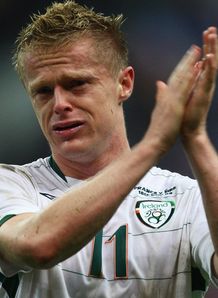
I would find it difficult to forgive most footballers for either of these ghastly crimes but Henry is not like most footballers. Henry is a king, a majestic footballer capable of acts of pure genius without any warning. In his devastating pomp, Henry outpaced every defender in the land in what seemed almost like a stroll. Henry was far too stylish to sprint, sprinting being the preserve of mere mortals like you and I. Instead, he glided past defender after defender with the most glorious nonchalance, echoing Eric Cantona, the player that paved the way for his arrival in the Premier League.
Most of the game's true striking greats are revered for one of two things: either a penchant for the truly breathtaking like the aforementioned Cantona or for a staggering goalscoring rate like banality's Alan Shearer. Henry was one of those rare players who could legitimately be accredited with both of these plaudits. Not content with simply scoring goals of astonishing ingenuity, Henry scored 30 goals or more in five consecutive seasons. No, I'm not on some sort of perverse acid trip full of made-up stats, he actually managed to do that. Who cares if he's now off in New York occasionally playing soccer matches, that phenomenal record seals his place as one of football's greats.
When measured against that crushing objectivity, any animosity I harbour for the man that dashed our World Cup qualification hopes (no, not Paul McShane, the French one) must take a backseat to respect and admiration. So through gritted teeth, I ackowledge Henry's genius and thank the footballing gods for giving me the opportunity to witness such a talent.
The ad's still rubbish though.
A Green Revolution
A 'new post' I wrote back in January for the Sunday Tribune's Pete Ball memorial competition. Unfortunately the paper met its demise before a winner could be judged so I'll just post it here. There's much I'd like to change in hindsight but here it is in unedited form anyway.
* * *
Slumped on the ground lay Richard Dunne, his body as shattered as his dream. Damien Duff's tears painted the picture of thousands of viewers back home. Giovanni Trapattoni cut the most forlorn of figures, a man deprived of the stage his glittering career deserved. Yet again, the Republic of Ireland football team would not be taking part in a major championship. For once, the finger of blame was pointed elsewhere but perhaps no more justifiably so than in any of our other failures.
Ireland's performance that night in Paris was nothing short of heroic. They showcased the attacking verve so rarely associated with Ireland, or indeed any of the British teams, with aplomb. This was in complete contrast with the whole qualifying campaign under Trapattoni, a football of dull numbness never more apparent than in the French game in Croke Park a mere four days before the Paris return leg.
Despite the clear difference bewteen the two performances and the undeniable superiorty of the second one, the Euro 2012 campaign has seen a return of rigid 4-4-2s and inflexible tactics. As a footballing nation we seem stuck in the dark ages, unable or unwilling to embrace contemporary styles. Failure to qualify for South Africa gave us a chance to overhaul the system, start anew. But attentions were focused elsewhere, specifically on how much of a cheating git Thiery Henry is and how the bullies at FIFA were being mean to us.
Appartently incapable of introspective analysis, we plunder on like gormless cavemen. At every level of the country we find the formation that Trapattoni and so many coaches before him favour: a flat back four, two holding midfielders, two wingers and two strikers. This has been the prevalant formation in football for years but its worth is declining rapidly. Last summer's World Cup proved beyond doubt that the 4-4-2 had been eclipsed as teams who preferred this system found themselves outplayed by fluid midfields, inverted wingers and rampaging wing-backs. Two of the tournaments biggest losers, Italy and England, both employed versions of the 4-4-2 and their swift exits were unsurprising if not inevitable.
The sole semi-finalist to use a 4-4-2 was Uruguay but theirs shared only nominal similarities with the other systems. The flexibility of their attacking quartet of Forlán, Suárez, Ledesma and Cavani was almost unrecognisable from England's disastrous Rooney-Heskey-Milner-Gerard axis.
With a population of only 3.5 million, you do not expect Uruguay to produce high-quality players so consistently yet their football history is as proud as almost any other nation's. Players are produced with ideals in mind, ideals that have been instilled into them from a very young age. In this sense, it is quite similar to the Ajax and Barcelona systems that have both dominated European football at one point or another. Though such a radical overhaul may seem inconceivable at the minute, I think it is a system that would benefit Irish football immeasurably should it be adopted.
First and foremost, this is not a change we will feel in the short-term. It may be fifteen years before a truly significant impact is made. However, this is no reason to dismiss the idea if the alternative is plodding along with the same outdated style for the next thirty years.
Change at grassroots level should be the priorty. Calls for pitch sizes for underage players to be reduced need to finally be heeded. At this level, emphasis should be switched from winning to playing good, productive football. Referees need not keep the scores of these matches and meaningless leagues should be abolished. As children progress through age levels, things can become gradually more competitive. Competitiveness will never be an issue, only the quality of our football. Our current system minimises player growth to unfathomable levels and it is antonishing that we have persisted with it for so long.
For this new system to work, it is imperative that a template is in place This means change at the top: the football of the national team must reflect the progressive style at youth level or, more accurately, vice versa.
The 2008 appointment of Wim Koevernens, former Netherlands national team youth coach, as high performance director was a promising signal of intent from the FAI. It will count for nothing if it is not built upon. Change must be embraced by not only those in administrative areas but by coaches and officials at underage levels throughout the country. If initiated now, perhaps we could reap the rewards of our forward-thinking at, say, Qatar 2022.
* * *
Slumped on the ground lay Richard Dunne, his body as shattered as his dream. Damien Duff's tears painted the picture of thousands of viewers back home. Giovanni Trapattoni cut the most forlorn of figures, a man deprived of the stage his glittering career deserved. Yet again, the Republic of Ireland football team would not be taking part in a major championship. For once, the finger of blame was pointed elsewhere but perhaps no more justifiably so than in any of our other failures.
Ireland's performance that night in Paris was nothing short of heroic. They showcased the attacking verve so rarely associated with Ireland, or indeed any of the British teams, with aplomb. This was in complete contrast with the whole qualifying campaign under Trapattoni, a football of dull numbness never more apparent than in the French game in Croke Park a mere four days before the Paris return leg.
Despite the clear difference bewteen the two performances and the undeniable superiorty of the second one, the Euro 2012 campaign has seen a return of rigid 4-4-2s and inflexible tactics. As a footballing nation we seem stuck in the dark ages, unable or unwilling to embrace contemporary styles. Failure to qualify for South Africa gave us a chance to overhaul the system, start anew. But attentions were focused elsewhere, specifically on how much of a cheating git Thiery Henry is and how the bullies at FIFA were being mean to us.
Appartently incapable of introspective analysis, we plunder on like gormless cavemen. At every level of the country we find the formation that Trapattoni and so many coaches before him favour: a flat back four, two holding midfielders, two wingers and two strikers. This has been the prevalant formation in football for years but its worth is declining rapidly. Last summer's World Cup proved beyond doubt that the 4-4-2 had been eclipsed as teams who preferred this system found themselves outplayed by fluid midfields, inverted wingers and rampaging wing-backs. Two of the tournaments biggest losers, Italy and England, both employed versions of the 4-4-2 and their swift exits were unsurprising if not inevitable.
The sole semi-finalist to use a 4-4-2 was Uruguay but theirs shared only nominal similarities with the other systems. The flexibility of their attacking quartet of Forlán, Suárez, Ledesma and Cavani was almost unrecognisable from England's disastrous Rooney-Heskey-Milner-Gerard axis.
With a population of only 3.5 million, you do not expect Uruguay to produce high-quality players so consistently yet their football history is as proud as almost any other nation's. Players are produced with ideals in mind, ideals that have been instilled into them from a very young age. In this sense, it is quite similar to the Ajax and Barcelona systems that have both dominated European football at one point or another. Though such a radical overhaul may seem inconceivable at the minute, I think it is a system that would benefit Irish football immeasurably should it be adopted.
First and foremost, this is not a change we will feel in the short-term. It may be fifteen years before a truly significant impact is made. However, this is no reason to dismiss the idea if the alternative is plodding along with the same outdated style for the next thirty years.
Change at grassroots level should be the priorty. Calls for pitch sizes for underage players to be reduced need to finally be heeded. At this level, emphasis should be switched from winning to playing good, productive football. Referees need not keep the scores of these matches and meaningless leagues should be abolished. As children progress through age levels, things can become gradually more competitive. Competitiveness will never be an issue, only the quality of our football. Our current system minimises player growth to unfathomable levels and it is antonishing that we have persisted with it for so long.
For this new system to work, it is imperative that a template is in place This means change at the top: the football of the national team must reflect the progressive style at youth level or, more accurately, vice versa.
The 2008 appointment of Wim Koevernens, former Netherlands national team youth coach, as high performance director was a promising signal of intent from the FAI. It will count for nothing if it is not built upon. Change must be embraced by not only those in administrative areas but by coaches and officials at underage levels throughout the country. If initiated now, perhaps we could reap the rewards of our forward-thinking at, say, Qatar 2022.
Leaving Facebook or why you should set yourself free
Last Sunday night I deleted my Facebook account. Or, to be more precise, deactivated it. For some reason Facebook does not explicitly give you the option of permanently deleting your account, instead preferring to save your information indefinitely. To delete all your personal details you must first submit a request to Facebook, an unnecessarily laborious task that many choose to skip in favour of deactivation.
Seeking to end my Facebook misery quickly, I deactivated my account. My reasons for this are myriad, yet Facebook boasts over 500 million users, a figure that is rising rapidly. Its popularity continues to grow and grow but I found its appeal had diminished a long time ago. No longer a pleasantly distracting social outlet, it has descended into a virus-ridden black hole where racism thrives and baseless conjectures masquerades as fact.
In an environment where no one deems it worthwhile to source information, anyone can post anything on Facebook and have it accepted as truth. The night I decided to close my account for good, I had seen a photograph of "the corpse" of Osama bin Laden, a doctored image that was about as legitimate as the lads with facial hair playing U-12 hurling. Within minutes of its posting, throngs of people had either commented on or 'liked' the photo, none questioning the veracity of the image even though the quickest of Google searches could have told them no such photo had been released to the public.
This was the straw that broke the camel's back, the final nail in the coffin and other such cliches. My affair with Facebook was over, roughly eighteen months after it began. It all seemed so innocent when I first logged on, an easy way of interacting with friends, sharing interests or finding new music. Gradually, so gradually that I hadn't even realised it until about two weeks ago, its innocence was lost. Every kind of warped prejudice frequently rears its head on the site, dominating the ubiquitous 'likes' that smother each news feed.
The decision to quit Facebook was an easy one and it's something that I have not regretted once in the five days since I left. I feel freer, no longer at the mercy of the temptation to refresh my news feed to see if anything interesting had happened in the last five minutes. In Twitter, I can enjoy an infinitely more refined social networking site where I can control what appears in my feed rather than being subjected to the dull ramblings (irony is not lost on me) of acquaintances whose friend requests I couldn't bring myself to decline out of politeness.
So goodbye Facebook, I have a suspicion that neither of us will miss each other that much. Meantime I'll try to keep up this blogging business, hopefully gain a few readers. I'll probably stick to football blogging in the future (I'm only trying to find my feet with this post) but I may delve into hurling or music the odd time. So, if anyone ever does read this, I hope it tickled your interest and perhaps made you consider your status on Facebook (yes, that was a laboured pun).
Seeking to end my Facebook misery quickly, I deactivated my account. My reasons for this are myriad, yet Facebook boasts over 500 million users, a figure that is rising rapidly. Its popularity continues to grow and grow but I found its appeal had diminished a long time ago. No longer a pleasantly distracting social outlet, it has descended into a virus-ridden black hole where racism thrives and baseless conjectures masquerades as fact.
In an environment where no one deems it worthwhile to source information, anyone can post anything on Facebook and have it accepted as truth. The night I decided to close my account for good, I had seen a photograph of "the corpse" of Osama bin Laden, a doctored image that was about as legitimate as the lads with facial hair playing U-12 hurling. Within minutes of its posting, throngs of people had either commented on or 'liked' the photo, none questioning the veracity of the image even though the quickest of Google searches could have told them no such photo had been released to the public.
This was the straw that broke the camel's back, the final nail in the coffin and other such cliches. My affair with Facebook was over, roughly eighteen months after it began. It all seemed so innocent when I first logged on, an easy way of interacting with friends, sharing interests or finding new music. Gradually, so gradually that I hadn't even realised it until about two weeks ago, its innocence was lost. Every kind of warped prejudice frequently rears its head on the site, dominating the ubiquitous 'likes' that smother each news feed.
The decision to quit Facebook was an easy one and it's something that I have not regretted once in the five days since I left. I feel freer, no longer at the mercy of the temptation to refresh my news feed to see if anything interesting had happened in the last five minutes. In Twitter, I can enjoy an infinitely more refined social networking site where I can control what appears in my feed rather than being subjected to the dull ramblings (irony is not lost on me) of acquaintances whose friend requests I couldn't bring myself to decline out of politeness.
So goodbye Facebook, I have a suspicion that neither of us will miss each other that much. Meantime I'll try to keep up this blogging business, hopefully gain a few readers. I'll probably stick to football blogging in the future (I'm only trying to find my feet with this post) but I may delve into hurling or music the odd time. So, if anyone ever does read this, I hope it tickled your interest and perhaps made you consider your status on Facebook (yes, that was a laboured pun).
Subscribe to:
Posts (Atom)